Introduction to AES: The Advanced Encryption Standard Explained Simply
If you have ever wondered how your passwords, bank details, or private messages stay safe online, you have already run into AES without knowing it. AES stands for Advanced Encryption Standard, and it is one of the most trusted tools for keeping digital information private. This guide breaks it down in plain language, one question at a time, so you walk away actually understanding how it works instead of just knowing the name.
1. What is the Advanced Encryption Standard?
AES is a method for scrambling data so that only someone with the correct key can read it. Think of it like a lockbox. You put your message inside, lock it with a secret key, and send it off.
Anyone who intercepts the box just sees a jumbled mess. Only the person with the matching key can unlock it and read the original message.
The U.S. government adopted AES in 2001 after a long public competition to find the strongest, most reliable encryption method available, and it has been the global standard ever since.

2. How does AES encryption work?
At a basic level, AES takes your original data, called plaintext, and runs it through several rounds of scrambling using a secret key.
Each round mixes the data up in a different way, so by the end, the output (called ciphertext) looks like random noise. The same key that scrambled it is used to unscramble it later.
The strength of AES comes from repeating this scrambling process multiple times, which makes it extremely hard for anyone without the key to reverse the process by guessing.
3. Is AES symmetric or asymmetric encryption?
AES is symmetric encryption. That means the same key is used to both lock (encrypt) and unlock (decrypt) the data.
This is different from asymmetric encryption, which uses two separate keys, a public one and a private one.
Symmetric encryption like AES is generally faster, which is why it is used for encrypting large amounts of data, like entire hard drives or ongoing internet traffic, while asymmetric encryption is often used for smaller tasks like safely sharing that secret key in the first place.
4. What are the 4 steps of AES?
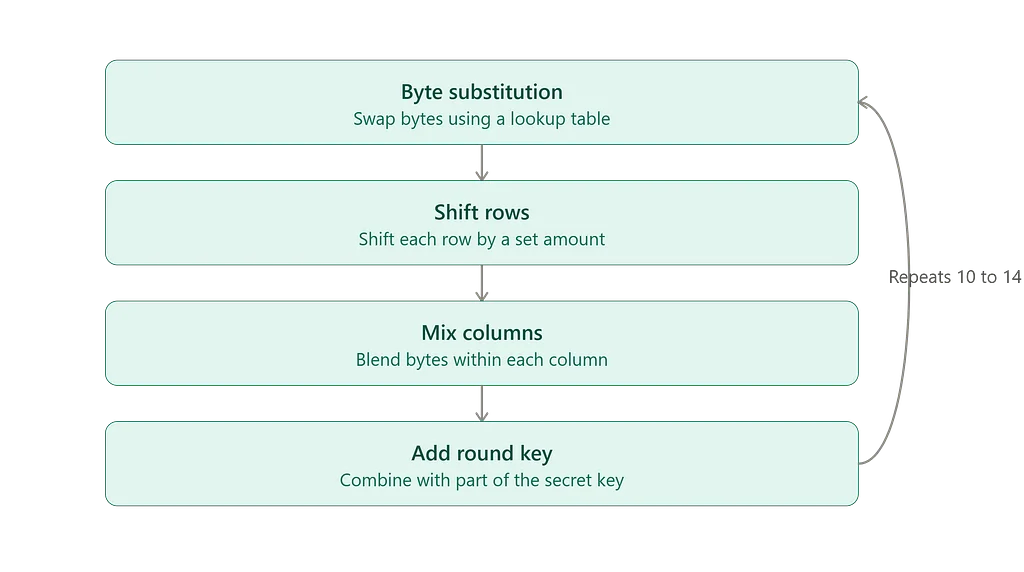
Each round of AES scrambling follows four repeating steps: byte substitution, shift rows, mix columns, and add round key.
These four steps happen over and over, usually 10, 12, or 14 times depending on the key size, before the final scrambled result is produced.
Each step does a different job, and together they make the output nearly impossible to predict or reverse without the key.
Let's look at each one individually.
5. What is byte substitution?
Byte substitution is the first step, and it replaces each byte of data with a different byte based on a fixed lookup table called an S-box.
This step is designed to remove any obvious patterns from the original data. Without it, similar pieces of plaintext might produce similar-looking ciphertext, which would give attackers clues.
Byte substitution breaks that pattern early, making the scrambling process much harder to reverse-engineer.

6. What is shift rows?
Shift rows takes the data, which is arranged in a small grid, and shifts each row over by a different amount.
The first row does not move, the second row shifts by one spot, the third by two, and so on. This step spreads the data around so that information from one part of the message gets mixed with information from other parts.
On its own, shifting rows does not scramble much, but combined with the other steps, it prevents patterns from staying in predictable positions.

7. What is mix columns?
Mix columns takes each column of the data grid and mathematically blends the bytes inside it together, so a change in one byte affects the entire column.
This step increases what is called diffusion, meaning a tiny change in the original message spreads out and affects a large portion of the final scrambled result.
Interestingly, this step is skipped in the very last round of AES, but included in every round before that.
8. What is add round key?
Add round key combines the current state of the data with a portion of the secret key, using a simple mathematical operation.
This step happens at the start of the process and after every round that follows. It is what actually ties the encryption to your specific secret key.
Without this step, the scrambling would be the same for everyone, no matter what key they used, which would make the whole system useless for keeping secrets.
9. Is AES-128 still secure according to NIST?
Yes. NIST's current cryptographic transition guidance (Special Publication 800-131A) lists AES-128, AES-192, and AES-256 as acceptable, and NIST has indicated AES-128 is expected to remain secure for the foreseeable future.
This is separate from a broader industry shift happening around 2030, when algorithms with less than 128 bits of security, like some older RSA key sizes, will be phased out. AES is not part of that transition, since even 128-bit AES already meets and exceeds the security bar being enforced.
AES comes in three key sizes, 128-bit, 192-bit, and 256-bit, with the number referring to how long the secret key is.
Longer keys are harder to crack through brute force guessing, so AES-256 is often recommended for highly sensitive data, but AES-128 remains strong enough for the vast majority of everyday encryption needs and has not been broken through any practical attack.
10. Is AES still used today?
Absolutely. AES is everywhere. It protects Wi-Fi connections, secures messaging apps, encrypts files on your phone and laptop, and keeps your online banking sessions private.
Governments, banks, and tech companies around the world rely on it daily.
More than two decades after it was adopted, no practical attack has broken AES when it is implemented correctly, which is a big reason it remains the go-to encryption standard rather than being replaced.
Conclusion
AES might sound intimidating at first, but it comes down to a repeating pattern of scrambling steps applied with a secret key, done well enough that nobody without that key can undo it.
Whether you are a developer, an IT professional, or just someone curious about how your data stays safe, understanding these basics gives you a real appreciation for the security working quietly in the background every time you send a message or make a purchase online.
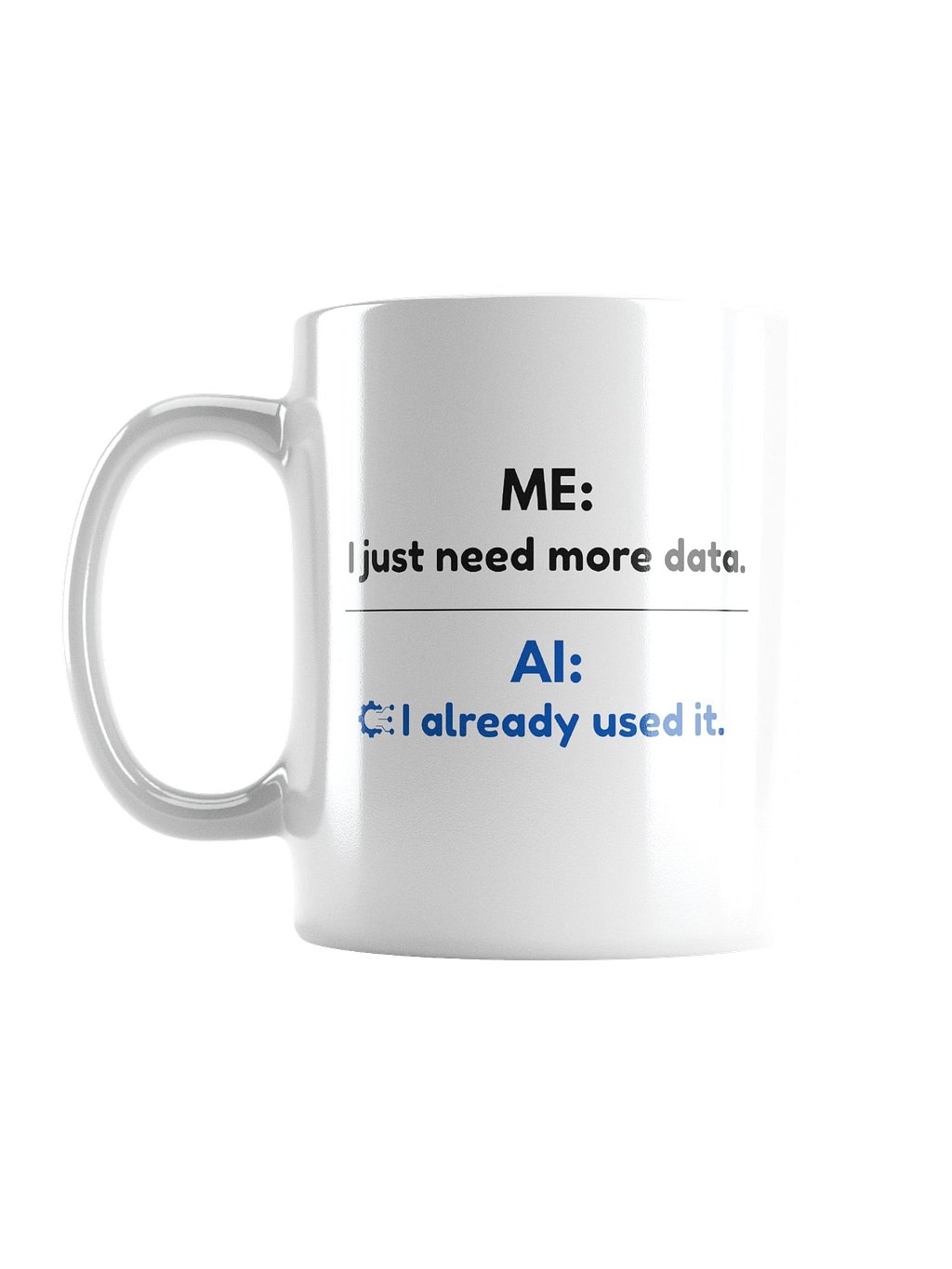
If you spend your days thinking about encryption, algorithms, and keeping systems secure, you already know the job comes with its fair share of dry humor. A funny marketing and tech humor mug makes a solid gift for the IT or security person on your team who deserves a laugh with their coffee.
Sources:
- NIST FIPS 197, Advanced Encryption Standard (AES) - the original 2001 standard defining the algorithm, key sizes, and the four-step round structure: https://tsapps.nist.gov/publication/get_pdf.cfm?pub_id=901427
- NIST SP 800-131A, Transitioning the Use of Cryptographic Algorithms and Key Lengths - current guidance on the security status of AES and other cryptographic algorithms: https://csrc.nist.gov/pubs/sp/800/131/a/r2/final
Until next time...
Digital Disasters and Delights!